Natural Burial at the Cumberland Cemetery
This page was last reviewed on July 17, 2026.
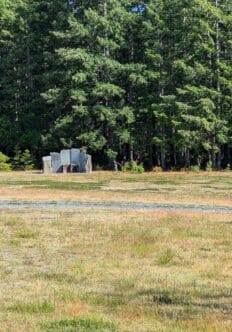 Cumberland Cemetery is an historic cemetery, established in 1895, and the resting place of generations of Cumberlanders. Natural burial is not new at the cemetery. Grave vaults and liners have never been required, resulting in a rustic natural landscape that is rolling and dry, the ground covered with moss and kinnikinnick.
The natural burial area was established in 2018 to provide a burial option for families that would impose the least possible environmental impact. Over time, the area has the potential to deliver a range of positive environmental benefits.
The natural burial area is a Green Burial Society of Canada certified site.
Principles of Natural Burial
The Green Burial Society of Canada has five principles of natural burial that are practiced at the cemetery:
- No embalming
- Direct earth burial
- Ecological restoration and conservation
- Communal memorialization
- Optimized land use
Find out more about these principles.
Natural Burial Features at the Cumberland Cemetery
Interment options in the natural burial area of the Cumberland Cemetery include
- lots for one full burial and a second burial of cremated remains, and
- smaller lots near the tree line for two sets of cremated remains.
Full burial can take place in casket or shroud made of biodegradable and environmentally sustainable materials. Cremation burials may be placed without a container or in a biodegradable container. Find details on container requirements in the Cemetery Bylaw.
Interments take place sequentially and graves are assigned following the cemetery layout plan once a death has occurred. Lots cannot be reserved. This allows the Village to plant native species of trees and plants as burials take place to optimize land use. Family and friends may participate in a graveside service through a funeral services provider or on their own.
Please contact a funeral director to discuss options for shrouds, caskets, and containers suitable for natural burial as well as transport options.
For information on home funerals and transport please review these resources:
Ministry of Health Planned Home Death
Private Transfer Following a Death, Consumer Protection BC
Consumer Information on Funeral Services
Green Burial Society of Canada
Memorialization
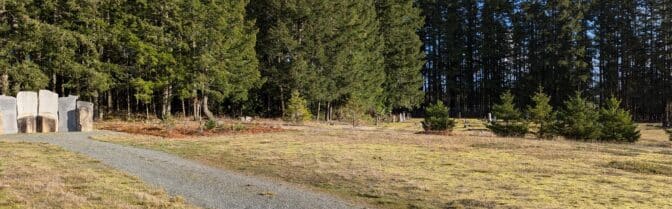
Staying true to the principles of natural burial, simple memorialization will take place through optional engraving on a common monument of black tusk basalt. Placement of personal mementoes on graves is discouraged other than at the time of interment.
Containers for Human Remains
A container enclosing human remains for interment must
- have a rigid base that permits the dignified transport and safe handling of the remains,
- be primarily constructed from fully biodegradable and environmentally sustainable materials,
- have its interior finished primarily fabricated of fully biodegradable and environmentally sustainable materials and natural fibres,
- have, as a function of its design, a safe and secure means with which to facilitate the dignified transfer of the human remains enclosed to the interment site and lowered into the excavated lot,
- have no extraneous part, fixture or decoration attached that is made of plastic, metal, or other non-biodegradable material, except for minimally necessary structural hinges, nails and screws,
- not have a high gloss or polish finish achieved through the application of any synthetic or environmentally hazardous, toxic or non-biodegradable chemical or agent,
- not been constructed with the use of any synthetic or environmentally hazardous, toxic or non-biodegradable glue, epoxy or other form of bonding agent,
- not have any interior liner, shroud, bag or other lining that is fabricated from a non-biodegradable material,
- not have any non-biodegradable personal items, memento, or article placed inside the space occupied by the human remains,
- not be primarily constructed from fibreboard, particleboard, plywood, non-sustainable or exotic wood, metal, bleached or non-recycled cardboard or other form of non-sustainable, non-biodegradable or artificial material,
- be approved for use by the cemetery manager before a scheduled interment.
Human remains proposed for interment in a natural burial area must not be embalmed, and only be clothed, wrapped or shrouded in natural and fully biodegradable fibre or material.
The removal of artificial joints, pacemakers, dental fillings or similar embedded, foreign materials for pacemakers, artificial joints, and dental fillings from human remains is not required.
Ecological Restoration and Landscaping
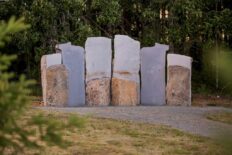
The long term goal for the natural burial area is to restore the natural habitat reflected the surrounding forest on the adjacent lands.
Plantings of native species take place once all interments in a row have been completed, then irrigation will be installed to establish and maintain plantings for that row to give the plantings the best chance of survival in the dry climate of the cemetery.
Plantings will be of hardy plants, and may include Douglas fir, white pine, huckleberry, flowering red currant, and creeping Oregon grape. Non-native plantings will be removed.
Natural Burial Fees
Fees for interment follow the general fee schedule for the Cumberland Cemetery.
Additional fees for ecological restoration through natural landscaping at collected at the time of interment. This landscaping will take place immediately after burial – only after all interments in a row of lots are completed.
Memorialization on the common monument is optional and fees cover the cost of engraving, plus a contribution to the placement of the black tusk basalt memorial.
Search again